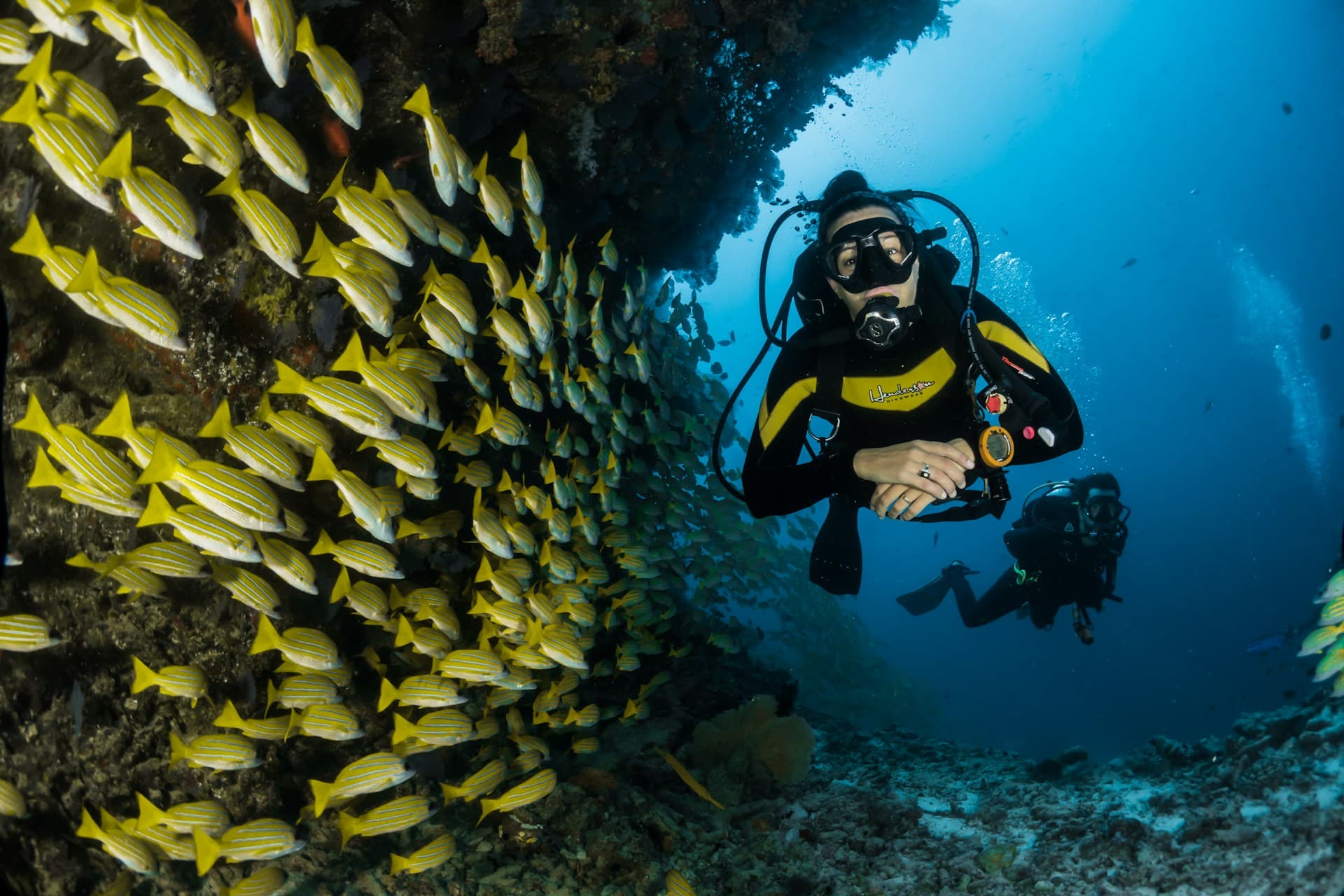

There is a moment on every dive when the surface world disappears and you enter a different reality — one governed by buoyancy, breath, and the silent choreography of marine life. The planet's best diving destinations each offer something unique: a species you cannot see anywhere else, a geological formation that defies imagination, or a density of life so overwhelming that you forget you are a visitor in an alien world.
These 12 destinations represent the pinnacle of recreational diving. Whether you are a newly certified Open Water diver or a seasoned technical diver with thousands of logged dives, at least one of these belongs on your list.
1. Great Barrier Reef, Australia
The Great Barrier Reef is the largest living structure on earth — 2,300 kilometers of coral reef visible from space. It supports over 1,500 species of fish, 400 types of coral, and an ecosystem so complex that scientists are still cataloging it.
What You Will See
Giant clam gardens, reef sharks, green and loggerhead sea turtles, manta rays, Maori wrasse (Napoleon fish), and an overwhelming diversity of tropical fish. During coral spawning (November), the entire reef releases eggs in a synchronized underwater snowstorm.
Dive Details
- Visibility: 15-30 m (better on the outer reef, 60+ km offshore)
- Water temperature: 22-29C (coldest July-August, warmest January-February)
- Certification level: Open Water for most sites; Advanced Open Water for deeper walls and drift dives
- Best season: June through November for the best visibility and calmest seas. Minke whale season is June-July on the northern reef.
- Cost per dive: 80-150 AUD for day trips from Cairns; 250-400 AUD/day for liveaboard trips (recommended for the best sites)
Getting There
Cairns is the primary gateway. Day boats reach the outer reef in 90 minutes. For the best diving, book a 3-7 day liveaboard to the Ribbon Reefs or Osprey Reef (Coral Sea), where visibility exceeds 40 m and pelagic encounters are common.
2. Raja Ampat, Indonesia
Raja Ampat holds the world record for marine biodiversity. A single dive site here can contain more species of coral and fish than the entire Caribbean. Located at the epicenter of the Coral Triangle, this remote archipelago in West Papua is the holy grail for serious divers.
What You Will See
Over 1,500 fish species and 600 coral species. Wobbegong sharks, manta rays at cleaning stations, walking sharks (epaulette sharks), pygmy seahorses, schools of barracuda and jacks, and reef systems so healthy they look like underwater gardens.
Dive Details
- Visibility: 15-30 m (variable due to nutrient-rich currents, which is precisely why biodiversity is so high)
- Water temperature: 27-30C year-round
- Certification level: Advanced Open Water recommended due to currents. Some sites are suitable for Open Water divers with good buoyancy.
- Best season: October through April (calmest seas, best manta season). Diving is possible year-round, but June-September brings stronger currents and rougher conditions.
- Cost per dive: 40-60 USD per dive at land-based resorts. Liveaboards run 300-600 USD/day all-inclusive. Raja Ampat marine park entry fee: 1,000,000 IDR (about 65 USD).
Getting There
Fly to Sorong (West Papua) via Jakarta or Makassar. From Sorong, take a ferry or speedboat to your resort or join a liveaboard. The journey is part of the adventure — Raja Ampat is not easy to reach, and that is part of its preservation.
3. Maldives
The Maldives is best known for overwater bungalows and honeymoon luxury, but beneath the surface lies some of the most spectacular diving in the Indian Ocean. The geography — 26 atolls with channels that funnel nutrient-rich water — creates feeding grounds for megafauna.
What You Will See
Manta rays (particularly at Hanifaru Bay, where hundreds gather to feed from June-November), whale sharks, hammerhead sharks (in the channels), reef sharks on almost every dive, turtles, and brilliantly healthy coral gardens.
Dive Details
- Visibility: 20-40 m (best January-April on the east side; May-November on the west side)
- Water temperature: 27-30C year-round
- Certification level: Open Water for inside-atoll diving. Advanced Open Water for channel dives (strong currents, deeper depths, shark encounters).
- Best season: Depends on what you want. January-April for best visibility on the east. May-November for manta season at Hanifaru Bay. Hammerheads are most common December-March.
- Cost per dive: 60-100 USD per dive at resorts. Liveaboards 200-400 USD/day all-inclusive.
Getting There
Fly to Male (Ibrahim Nasir International Airport). Domestic flights or speedboats reach individual atolls. Liveaboards depart from Male and cover multiple atolls in a single trip — by far the best way to experience the diving.
4. Red Sea (Egypt)
The Red Sea offers an extraordinary combination of accessibility, affordability, and world-class diving. From shore-accessible house reefs in Dahab to legendary wrecks in the Strait of Gubal, the Red Sea covers every type of diving experience.
What You Will See
The SS Thistlegorm (a WWII cargo ship sunk by German bombers, considered the world's best wreck dive), coral gardens at Ras Mohammed National Park, Napoleon wrasse, oceanic whitetip sharks (Brothers Islands), dolphins, dugongs (in Marsa Alam), and eagle rays.
Dive Details
- Visibility: 20-40 m (some of the clearest tropical water in the world)
- Water temperature: 21-28C (coolest January-March, warmest July-September)
- Certification level: Open Water for reef diving. Advanced Open Water for deeper wrecks and drift dives. The Thistlegorm can be done at Open Water level but is better appreciated with experience.
- Best season: March through May and September through November for the best balance of water temperature and visibility. Summer is hot (40+C on land) but the water is warm and the diving is excellent.
- Cost per dive: 30-50 USD per dive — exceptionally good value for the quality. Liveaboards run 100-200 USD/day.
Getting There
Sharm el-Sheikh and Hurghada are the main dive bases, with direct flights from most European cities. Dahab (on the Gulf of Aqaba) is a more relaxed alternative. Marsa Alam is the base for the southern Red Sea.
5. Galapagos Islands, Ecuador
The Galapagos is not about coral — it is about animals. The convergence of cold and warm ocean currents creates a feeding ground that attracts marine life on a scale found nowhere else. This is big-animal diving at its most intense.
What You Will See
Hammerhead sharks in massive schools (hundreds at Wolf and Darwin islands), whale sharks (June-November), marine iguanas, sea lions that swim with you, mola mola (ocean sunfish), penguins, and Galapagos sharks.
Dive Details
- Visibility: 10-25 m (variable due to nutrient-rich currents and plankton that feeds the ecosystem)
- Water temperature: 16-26C depending on season and site. The cold is no joke — many divers wear 7mm wetsuits or drysuits.
- Certification level: Advanced Open Water minimum. Many operators require 50+ logged dives and experience with currents. Wolf and Darwin are not for beginners.
- Best season: June through November for whale sharks and the largest hammerhead schools. Water is colder (18-22C). January through May is warmer but with less predictable big-animal encounters.
- Cost per dive: Only accessible by liveaboard. Expect 500-800 USD/day for a 7-10 day trip. Galapagos National Park fee 100 USD.
Getting There
Fly to Baltra or San Cristobal from Quito or Guayaquil. Liveaboards depart from these ports. The best dive sites (Wolf and Darwin) are a 12-18 hour sail from the main islands.
6. Komodo National Park, Indonesia
Komodo is famous for its dragons, but the underwater world is equally spectacular. The park sits where the Indian and Pacific Oceans meet, and powerful currents deliver nutrients that support an explosion of marine life.
What You Will See
Manta rays (at Manta Point and Cauldron), reef sharks, sea turtles, Napoleon wrasse, cuttlefish, nudibranchs, and some of the most pristine hard coral in Asia. Current-swept walls are covered in soft corals and sea fans.
Dive Details
- Visibility: 15-30 m (best in dry season)
- Water temperature: 22-29C (the southern sites can be surprisingly cold due to upwellings)
- Certification level: Advanced Open Water recommended. Currents can be strong and unpredictable. Good buoyancy control is essential.
- Best season: April through November. March-April and October-November are sweet spots with good visibility and calmer seas. December-February is rainy season with reduced visibility.
- Cost per dive: 40-70 USD per dive from Labuan Bajo. Liveaboards 200-400 USD/day. Komodo National Park fee approximately 350,000 IDR.
Getting There
Fly to Labuan Bajo (Flores) from Bali or Jakarta. Labuan Bajo is the gateway to the park, with dozens of dive operators and liveaboards available.
7. Sipadan, Malaysia
Sipadan is a volcanic oceanic island off Borneo that rises 600 meters from the seabed. The wall diving here is legendary — you drop off the edge of the reef into the blue, surrounded by turtles, sharks, and massive schools of barracuda and jacks.
What You Will See
Barracuda tornadoes (swirling schools of thousands), green and hawksbill sea turtles (often 20+ per dive), whitetip and grey reef sharks, bumphead parrotfish herds, and the Turtle Tomb — a cave containing the skeletons of turtles that became trapped inside.
Dive Details
- Visibility: 20-40 m
- Water temperature: 27-30C year-round
- Certification level: Advanced Open Water recommended for wall dives. The Turtle Tomb requires cave diving certification.
- Best season: Year-round, though April through December tends to have better visibility. Monsoon (December-February) can reduce visibility but rarely affects diving.
- Cost per dive: 50-80 USD per dive. Only 120 dive permits are issued per day — book well in advance through a Mabul or Kapalai-based resort.
- Permit requirement: Sipadan permits are allocated to dive resorts. You must stay at a partner resort on Mabul or Kapalai island to receive a permit.
Getting There
Fly to Tawau (Sabah, Malaysian Borneo), then transfer to Semporna and boat to Mabul island. The journey takes most of a day from Kuala Lumpur.
8. Cenotes, Yucatan, Mexico
The Yucatan Peninsula is riddled with cenotes — freshwater sinkholes connected by underground river systems that run for hundreds of kilometers through limestone. Diving a cenote is unlike any other dive on earth: crystal-clear freshwater, light beams piercing the darkness, stalactites and stalagmites, and haloclines where fresh and salt water meet.
What You Will See
Not marine life — cenote diving is about geology and light. Stalactites and stalagmites formed over millennia, shafts of sunlight penetrating from above, halocline effects (where visibility blurs as fresh and salt water mix), and fossils embedded in the limestone walls.
Dive Details
- Visibility: 50-100+ m in fresh water — the clearest diving on earth
- Water temperature: 24-25C year-round
- Certification level: Open Water for cavern dives (always within sight of natural light). Full cave certification for system penetration.
- Best season: Year-round. Rain (June-October) can reduce visibility slightly but cenotes are largely unaffected by weather.
- Cost per dive: 60-100 USD for two-tank cenote dives from Playa del Carmen or Tulum.
Getting There
Fly to Cancun and drive south to Playa del Carmen or Tulum (1-2 hours). Most cenotes are within 30-60 minutes of these towns.
9. Palau, Micronesia
Palau is a tiny Pacific island nation with an outsized reputation in the diving world. The combination of Rock Islands, Jellyfish Lake, and nutrient-rich currents creates a diversity of dive experiences unmatched in such a small area.
What You Will See
Sharks, sharks, and more sharks — Palau is the world's first shark sanctuary. Reef sharks, grey reef sharks, bull sharks, and occasionally hammerheads. Also: manta rays, Napoleon wrasse, giant clams, and the unique experience of Jellyfish Lake (snorkeling, not diving, among millions of non-stinging jellyfish).
Dive Details
- Visibility: 20-40 m
- Water temperature: 28-30C year-round
- Certification level: Advanced Open Water recommended. Blue Corner (Palau's most famous site) involves hooking into the reef in strong current to watch sharks — not for beginners.
- Best season: October through May (drier). Diving is excellent year-round.
- Cost per dive: 80-120 USD per dive. Jellyfish Lake permit: 100 USD.
Getting There
Fly to Koror via Guam, Manila, Taipei, or Seoul. Palau is remote — plan for a full day of travel from most starting points.
10. Bonaire, Caribbean Netherlands
Bonaire is the shore-diving capital of the world. The entire leeward coast is a marine park, with over 80 marked dive sites accessible directly from the beach. Rent a truck, load your gear, and dive at your own pace — no boat, no schedule, no dive guide needed.
What You Will See
Healthy Caribbean reef: seahorses, frogfish, turtles, spotted eagle rays, reef squid, moray eels, and a coral reef system that decades of protection have kept in excellent condition. The night diving from shore is particularly rewarding — octopus, tarpon, and bioluminescence.
Dive Details
- Visibility: 20-40 m
- Water temperature: 26-29C year-round
- Certification level: Open Water is sufficient for most shore dives. Sites are well-marked with mooring stones indicating entry points.
- Best season: Year-round. Bonaire is outside the hurricane belt. October-November has the calmest seas.
- Cost per dive: Shore diving is essentially free once you have gear. Tank fills: 5-8 USD. Full equipment rental: 30-50 USD/day. Marine park tag: 45 USD/year.
Getting There
Direct flights from Amsterdam (8.5 hours), or connect via Curacao, Miami, or Houston. Bonaire is a small island — the airport is 10 minutes from most dive sites.
11. Cozumel, Mexico
Cozumel is drift-diving paradise. The Mesoamerican Barrier Reef system (the second-largest in the world) runs along the island's southwest shore, and a consistent current carries you along walls, overhangs, and coral gardens while you float effortlessly.
What You Will See
Splendid toadfish (endemic to Cozumel — found nowhere else on earth), nurse sharks, eagle rays, sea turtles, and vibrant sponge-covered walls. The soft corals and sea fans are some of the most photogenic in the Caribbean.
Dive Details
- Visibility: 25-40 m (consistently excellent)
- Water temperature: 25-29C year-round
- Certification level: Open Water for most drift dives (the current does the work). Palancar Caves and Devil's Throat require Advanced Open Water.
- Best season: Year-round, though March-June typically has the best visibility. Hurricane season (August-October) can bring rough seas but rarely affects diving significantly.
- Cost per dive: 60-90 USD for a two-tank boat dive.
Getting There
Fly to Cozumel directly (from US hubs) or fly to Cancun and take the ferry from Playa del Carmen (45 minutes, about 20 USD each way).
12. Belize Blue Hole
The Great Blue Hole is a giant marine sinkhole — 300 meters across and 125 meters deep — visible from space. Diving into the abyss and descending past massive stalactites is a bucket-list experience, even if the marine life is not the main attraction.
What You Will See
The main event is geological: stalactites the size of cars hanging at 40 m depth, formed when this was a dry cave during the last Ice Age. Bull sharks and reef sharks patrol the rim. The surrounding Lighthouse Reef atoll offers superb wall diving with more traditional marine life.
Dive Details
- Visibility: 30-40 m in the Blue Hole itself. 20-30 m on surrounding reefs.
- Water temperature: 26-29C year-round
- Certification level: Advanced Open Water required for the Blue Hole dive (reaching 40 m depth). Open Water is fine for the surrounding reef dives.
- Best season: April through June for the best weather and visibility. Year-round diving is possible.
- Cost per dive: 250-350 USD for a Blue Hole day trip from Ambergris Caye or Caye Caulker (includes 3 dives — one in the Blue Hole plus two on Lighthouse Reef). Regular reef dives: 50-80 USD.
Getting There
Fly to Belize City, then take a puddle-jumper to Ambergris Caye or a water taxi to Caye Caulker. The Blue Hole is a 2.5-hour boat ride from Ambergris Caye.
Planning Your Dive Trip
A few tips that apply to all diving travel:
- Log your dives: Many operators at premium sites require proof of experience (50+ dives for currents, 100+ for certain sites).
- Bring your own mask and computer: Rental gear is fine for most equipment, but a well-fitting mask and your own dive computer are worth the luggage space.
- Buy dive insurance: DAN (Divers Alert Network) membership includes evacuation coverage and hyperbaric chamber access worldwide. It costs 40-75 USD/year and is non-negotiable for serious dive travel.
- Allow surface intervals before flying: Wait at least 18-24 hours after your last dive before flying. Plan your last dive day accordingly.
- Consider liveaboards: For remote destinations (Raja Ampat, Galapagos, Maldives), liveaboards provide access to sites that shore-based divers never see.
TripGenie can help you plan a dive trip that maximizes your bottom time. Tell us your certification level, experience, and what you want to see, and our AI will recommend the best destinations, seasons, and operators for your diving goals.
Topics

Written by
TripGenie Team
The TripGenie team is passionate about making travel planning effortless with AI. We combine travel expertise with cutting-edge technology to help you explore the world.
@tripgenieGet Travel Tips Delivered Weekly
Get our best travel tips, destination guides, and exclusive deals delivered straight to your inbox every week.
No spam, ever. Unsubscribe anytime.